The OMB Directive (OMB-2026-10817) and the Search Visibility Problem Universities Are Not Ready For

Updated: Jun 26

A new federal directive is about to fundamentally change what universities and research institutions can publish, promote, and charge to federal awards. Most institutions are not ready. Fewer still understand that this is not just a compliance problem, it is a search visibility and AI citation problem.
OMB-2026-10817, a proposed revision to the Uniform Grants Regulation (2 CFR Part 200), known simply as the UGR, represents the most significant overhaul of federal grant compliance standards in decades.
For institutions that depend on federal research funding, the implications extend far beyond the grants office. They reach into web content, social media, marketing communications, faculty profiles, program descriptions, and publication strategies, and by extension, into every channel where those institutions are found, cited, and trusted online.
This post covers three things:
Author Note: I am not legal counsel. As a proposed rule, OMB-2026-10817 may be modified, delayed, or partially enjoined before or after its effective date. All compliance assessments should be treated as planning-level risk evaluations, not legal determinations. Institutional counsel should be involved in remediation decisions.
What OMB-2026-10817 Actually Requires
Published May 29, 2026, OMB-2026-10817 carries a proposed effective date of October 1, 2026. The rule is still in proposed form, and several provisions are expected to face legal challenge before or after the effective date. That uncertainty does not reduce the value of early assessment: compliance review at scale takes time, and the audit process itself is useful regardless of which provisions survive legal scrutiny.
The directive operates on two independent tracks.
Track 1: Prohibited Content
The directive identifies 14 categories of content that federal award recipients may not fund, promote, or facilitate. What distinguishes this from prior compliance frameworks is the organizational scope of §200.300: recipients must certify that no institutional policies or practices (entity-wide, not just at the program level) conflict with these prohibitions.
This means a university's public-facing website, its marketing materials, its training content, and its social media are all in scope, even when they are not directly charged to a specific federal award. The certification is about what the organization does and says broadly, not only what it bills to individual grant line items.
Prohibited Content Category | Regulatory Basis |
DEI/DEIA programs, commitments, and content | §200.300(b) |
Gender identity framing distinct from biological sex | §200.300(b)(2) |
Pediatric gender transition content | §200.300(b)(2) |
Disparate-impact framing or liability advocacy | §200.218 |
Issue advocacy and political activity | §200.450 |
Voter registration assistance | §200.450 |
State or political influence campaigns | §200.450 |
Non-English content on federally funded platforms | §200.111 |
Race-conscious preferences in admissions, hiring, or contracting | §200.205 |
References to elective abortion services | §200.477 |
Viewpoint discrimination against students or faculty | §200.219 |
Covered foreign collaborations (China, Russia, Iran, North Korea) | §200.220 |
Content supporting undocumented students | §200.205(b)(3) |
Content characterized as anti-American | §200.205(b)(4) |
Track 2: Cost Allowability
The directive also restricts or eliminates allowability for several cost categories common in academic grant budgets. These restrictions apply regardless of research topic. A lab doing materials science or cancer research with no prohibited content anywhere on its site is still exposed to the article processing charge restrictions if it charges open-access publication fees to federal awards.
Cost Category | Status Under the Directive | Regulatory Basis |
Article processing charges / open-access fees | Unallowable by default unless award terms expressly require | §200.461 |
Lobbying and advocacy costs | Unallowable | §200.450 |
DEI-related staffing, programming, and office costs | Unallowable | §200.300(b) |
Entertainment expenses | Unallowable | §200.438 |
Alumni activities | Restricted; prior approval required | §200.432 |
Foreign travel | Additional scrutiny required | §200.220 |
An Important Distinction: The two tracks are INDEPENDENT.
Compliance with prohibited content does not eliminate cost allowability exposure, and vice versa. Institutions must evaluate both tracks for every federally funded activity.
How the Directive Affects Search Engine and AI Visibility
This is where most institutions have not focused yet. Federal compliance and digital visibility are typically handled by entirely separate teams: the grants office on one side, communications and marketing on the other. The directive requires significant coordination across these teams.
What Built University Search Authority, and What Is Now at Risk?
Over the past decade, universities built substantial organic search authority through exactly the kinds of content the directive now restricts. DEI initiative pages, equity frameworks, diversity commitments in mission statements, community engagement programs, and international research partnership profiles were not merely expressions of institutional values. They were high-performing content types: frequently linked-to, cited by other authoritative sources, and semantically rich.
Search engines reward content that is authoritative (linked from many trusted sources), topically comprehensive, and institutionally anchored. DEI and social impact content checked all three boxes:
Generated inbound links from advocacy organizations, government agencies, peer institutions, and alumni networks.
Provided semantic depth across a broad range of social, community, and research terms.
Reinforced the institutional entity signal: The signal that tells Google, Bing, and other engines that a university is a known, trusted, authoritative actor in higher education.
Removing or significantly rewriting that content does not simply eliminate a few pages. It disrupts internal linking structures, breaks the inbound link equity pointing to removed pages, and erodes the topical authority clusters that took years to build. In competitive search environments (graduate program admissions, research area visibility, faculty recruitment) those gaps are measurable and consequential.
The AI Platform Dimension
The impact on AI-powered search platforms may be more significant than the organic search impact, and it is almost entirely unrecognized in higher education communications.
Google AI Overviews, AI Mode, ChatGPT Search, Perplexity, Gemini, and similar platforms do not simply index web pages; they build entity models. When someone asks an AI search platform about a University, a Research Center, or a Faculty Member's work, the response draws on a structured understanding of that entity: its mission, its research focus, its partnerships, its track record. That structured understanding is built from the content available in its training data and what it finds on the public web.
The directive creates several specific dynamics for AI platform visibility:
Entity Richness:
AI search systems prefer to cite sources with comprehensive, authoritative entity profiles. Mission statements, program descriptions, community impact narratives, and partnership announcements all contribute to that profile. Institutions that hollow out these signals (even for legitimate compliance reasons) may find themselves cited less frequently in AI-generated responses on topics they previously owned.
Citation Surface:
AI platforms rely on publicly crawled web pages as a primary input. Fewer pages, thinner content, and restricted topic coverage directly reduce the surface area available for AI citation. This is particularly significant for individual academic researchers, whose citation worthiness in AI platforms depends heavily on published faculty profiles, departmental pages, and affiliated program descriptions.
Competitor Vacuum:
Private institutions and international universities not subject to UGR are unlikely to restrict their content in the same way. In AI search environments, authority vacated by one institution is typically absorbed by a competitor. If your program in global health, public policy, or social medicine historically generated AI citations for relevant research queries, and you thin or remove the content anchoring that authority, a competitor institution with an unchanged content profile is positioned to fill that gap.
Foreign Collaboration Restrictions:
Section 200.220 creates new compliance obligations around research partnerships with covered foreign entities in China, Russia, Iran, and North Korea. International partnerships have historically been prominent features of university research spotlights, faculty profiles, and program descriptions, precisely the content types that generate inbound links and AI citation surface.
Institutions with active international research programs need to assess whether continuing to feature those partnerships in public web content creates compliance risk, even when the underlying research has been approved through proper institutional channels.
The Practical Outcome:
Institutions face a tradeoff between full compliance, which may reduce search and AI visibility in the short term, and delayed compliance, which carries regulatory and funding risk. Resolving that tradeoff requires knowing precisely what content is at risk, how much visibility exposure is involved, and whether content can be rewritten or must be removed. That is an audit problem before it is a strategy problem.
What a UGR Compliance Audit Produces, and How to Use It
A UGR (Uniform Grants Regulation) Compliance Audit gives institutions a structured, actionable picture of their exposure before a federal review, a grant recertification, or a content strategy decision requires them to act under pressure.
What the Audit Covers
The audit screens content against both tracks of the directive (all 14 prohibited content categories and all restricted cost allowability categories) across five content types:
Public-facing web pages: individual pages or full-site batch audits via crawl export.
Documents: grant applications, program descriptions, annual reports, policy documents
Social media content
Video and Multimedia descriptions
Email communications and marketing materials
For web content at scale, the audit integrates with full-site crawl exports (from scraper tools like Screaming Frog) allowing an entire university domain to be screened in a single pass rather than page by page.
The Severity Framework
Every finding is assigned one of four classifications:
Severity | Definition | Typical Action |
HIGH | Content explicitly falls within an enumerated prohibited category. | Rewrite or remove before next federal certification. |
MEDIUM | Content activity may not be an allowable charge to federal awards, or content touches restricted areas without a direct violation. | Legal or compliance review; consider funding reclassification. |
LOW | Content could be interpreted as borderline under the directive. | Internal review recommended before next publication cycle. |
CLEAR | No compliance issue identified. | No action required. |
What the Deliverables Look Like
The audit produces findings at two levels.
For single-page or document reviews, each finding includes the exact content excerpt, the regulatory basis, the severity level, and a recommended action: rewrite, remove, reclassify funding, or seek legal counsel. Where a rewrite is recommended, the report includes suggested revision language.
For batch audits of larger content inventories, findings are consolidated into a three-tab Excel workbook:
Overview: An executive scorecard with total counts by severity, a summary table listing every flagged page with its highest severity and recommended action, and full audit scope documentation. This tab is designed for senior leadership and the grants office. See example below.
Detailed Findings: Detailed flag blocks for each flagged item, with the content excerpt, issue explanation, regulatory basis, and suggested revision language where applicable. This tab is built for communications and content teams who will execute remediation.
URL Audit: A complete row-per-page table covering every page in the crawl, with severity-coded status, content category, and notes. Filterable by severity, making it straightforward to export a prioritized work list.
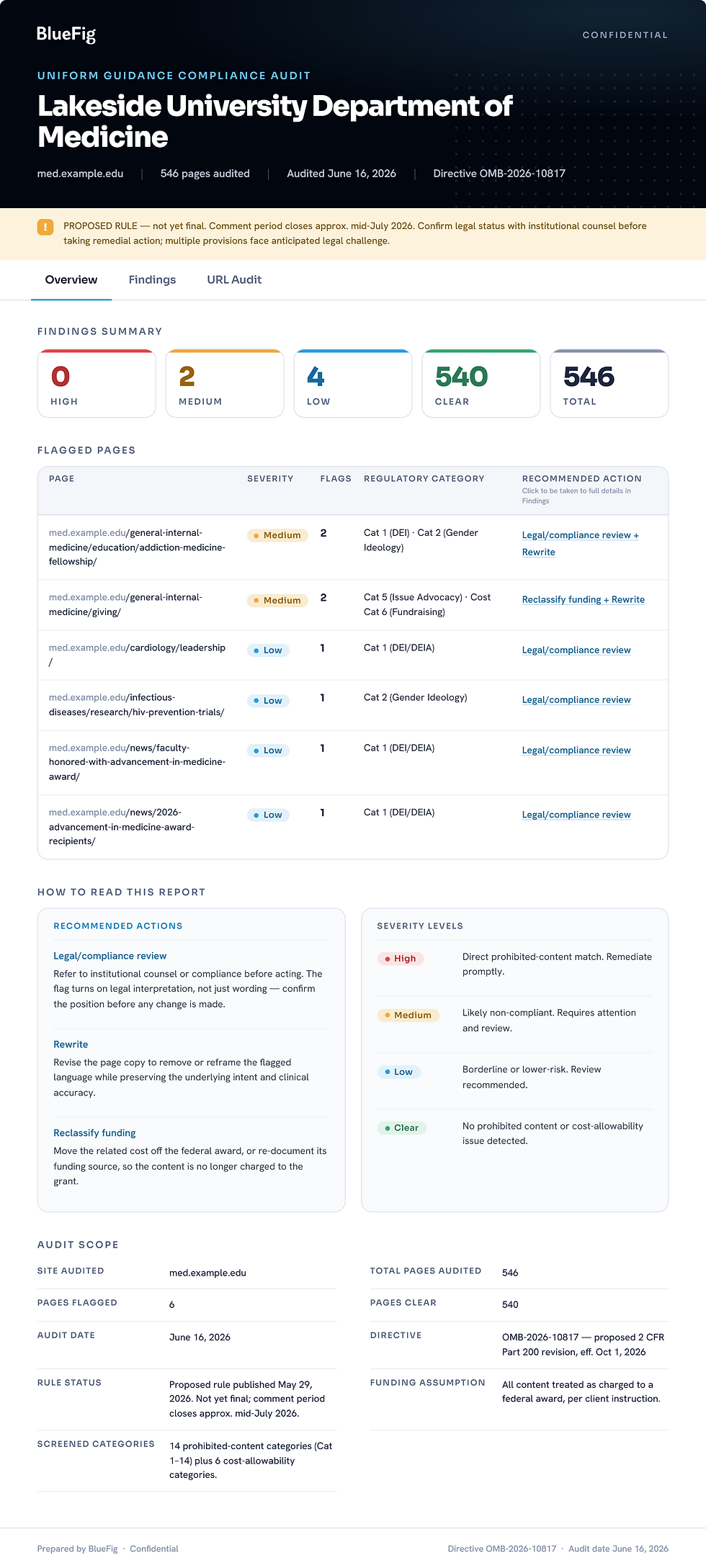
View a fully interactive example report here on Desktop. The example report does not render well on Mobile (screenshots of tabs still available on Mobile).
How Institutions and Researchers Use the Audit
Pre-Certification Use Case:
The most common use case is a pre-certification sweep. Before a grant renewal, a compliance certification submission, or an institutional audit, running the tool against all public-facing content associated with federal awards gives the grants office and the communications team a shared, prioritized work list with clear severity tiers and recommended actions. The two teams are working from the same findings rather than from separate assessments that may conflict.
Continuous Quality Control Use Case:
A second use case is ongoing content governance: screening new content before it is published. The audit can function as a checkpoint in the editorial review process, ensuring that new web pages, press releases, program announcements, social posts, and marketing materials do not create compliance exposure before they go live.
For individual academic researchers operating lab websites or program pages outside the central university content management system, the audit can be run against a single site in under an hour, producing a complete picture of exposure without requiring access to institutional compliance infrastructure.
What to Do Next
The intersection of federal compliance and digital visibility is unfamiliar territory for most higher education communications and marketing teams. It is also exactly the kind of problem where early preparation has an outsized advantage over reactive response.
If your institution or research program receives federal funding and maintains a public-facing web presence, now is the right time to understand your exposure. The directive's proposed effective date is October 1, 2026. Content inventories at major research universities are large, remediation takes time, and internal alignment between grants, legal, and communications does not happen quickly.
Contact BlueFig to discuss how a UGR compliance audit can help your institution assess content risk, protect your search and AI visibility, and prepare for what is coming.